March 15, 2026

Problem 2 - Deploy a Reserve - Translated

Apologies for the delay for this translation.. a change of jobs, change of house, etc. have been keeping me busy.

As always, in the translation that follows, translated text will be in black text and my comments in blue

For this second problem I have made a big adjustment… I had a lot of trouble deciphering and reading the Fraktur font for Problem 1, and though I did do a translation of Problem 2 myself, I enlisted the help of my AI friend to give me an assist.  Through some prodding and back and forth we came up with what you will find below.

Starting with Problem 2 I am providing a side-by-side translation of the original German text, preserving Rommel’s wording as closely as possible so readers can see exactly how orders and tactical situations were presented. The goal is to make these exercises accessible to English-speaking readers while remaining faithful to the original text. I got this idea after re-reading a translation of Caesar’s Gallic Wars.

There will not be a Combat Mission scenario accompanying this translation… the situation does not really warrant the time and effort needed to create the map and program the scenario. However, please read through the text and I will share some thoughts at the end, I promise that there are useful lessons in every one of these tactical problems. 

Problem 2 Deploy a Reserve 

German Text

English Translation

Situation

2. Aufgabe

Übungszweck: Entfaltetes Vorführen einer Reserve.

Truppe: 1 Schützenkompanie.

Lage: Blau im Angriff, Front nach Osten!

Zur Verfügung des Bataillonsführers liegt die 1./I.R.1 leicht eingegraben seit 1½ Stunden an einem [steileren/steileren?] Hang.

M.G. sind freigemacht.

Kampfeindrücke: Die deckungslose, 1500 m breite Wiesenfläche ostwärts der Kompanie wird von feindlicher Artillerie zeitweise kräftig abgefeuert.

In der Luft kreist zur Zeit 1 fdl. Staffel.

Problem 2

Training purpose: Deploy a reserve.

Troops: 1 Rifle Company.

Situation: Blue is attacking, front facing east!

At the Battalion commander’s disposal, 1st Company/Infantry Regiment 1 has been lightly dug in for 1½ hours on a [steeper] slope.

The machine guns have cleared fields of fire.

Combat impressions: The coverless meadow, 1500 meters wide, east of the company is being heavily shelled at intervals by enemy artillery.

At present, one enemy air formation is circling overhead.


Expected Course of Events Part I

Gedachter Verlauf.

I. Teil: Der Bataillonsführer (reitende) befiehlt nach Übungsbeginn dem Kompanieführer mündlich:

„Angriff geht gut vorwärts! 2. und 3. Komp. haben erreicht ...


Der Bataillonsgefechtsstand wird nach dem Ostrand des Y-Waldes vorverlegt.

Die 1. Kompanie, weiterhin zu meiner Verfügung, erreicht den Nordteil des Y-Waldes.“

Intended course of events.

Part I: After the exercise begins, the Battalion commander (mounted) gives the Company commander the following verbal order:

“The attack is progressing well! The 2nd and 3rd Companies have reached ...

(NOTE: The ellipsis and incomplete sentence is in the original)

The Battalion command post is being moved forward to the eastern edge of Y Wood.

1st Company, still at my disposal, will reach the northern part of Y Wood.”

Company Commander’s Order

Der Kompanieführer befiehlt den durch Zeichen zu ihm befohlenen Zugführern:

„Angriff des Bataillons geht gut vorwärts!

Der Bataillonsgefechtsstand wird nach dem Ostrand des Y-Waldes vorverlegt.

1. Kompanie, weiterhin zur Verfügung des Bataillons, rückt entfaltet nach dem Nordteil des Y-Waldes:

„Komp.Keil! Marschrichtung die hohe Tanne links der Straße!

Komp.Trupp bei 1. Zug! Ich reite voraus!“

The Company commander orders the platoon leaders, who have been called to him by signal:

“The Battalion’s attack is progressing well!

The Battalion command post is being moved forward to the eastern edge of Y Wood.

1st Company, still at the disposal of the Battalion, advances in deployed formation toward the northern part of Y Wood:

“Company wedge! Direction of march: the tall fir left of the road!

Company headquarters detachment with 1st Platoon! I ride ahead!”

1st Platoon Leader’s Order (This is a separate subordinate order, not just a repeat of the Company order.)

Der Führer des 1. Zuges befiehlt den Gruppenführern:

„Angriff geht gut vorwärts!

Die Kompanie, weiterhin zur Verfügung des Bataillons, rückt nach jenem Walde dort links der Straße.

Der 1. Zug verläßt entfaltet in Keilform diese Deckung hier.

Marschrichtung die hohe Tanne dort drüben!

1. Gruppe sofort antreten!“

The leader of 1st Platoon orders the squad leaders:

“The attack is progressing well!

The Company, still at the disposal of the Battalion, is moving toward that wood there to the left of the road.

1st Platoon leaves cover here in deployed wedge formation.

Direction of march: the tall fir over there!

1st Squad, step off at once!”

Alternate Method of Giving the Platoon Order

Oder er befiehlt durch Zeichen wie bei Aufgabe 1 und unterrichtet die Gruppenführer während des Vorgehens über die Lage.

Or he gives the order by signals as in Problem 1 and informs the squad leaders about the situation while moving forward.

This allows the Platoon Leader to get the platoon moving immediately, filling in details while already moving forward.

Expected Course of Events Part II

II. Teil: Den im Nordteil des Y-Waldes eintreffenden Zügen werden vom Kompanieführer neue Bereitstellungsräume zugewiesen.

Die Züge nisten sich ein!

Die Erkundung des Vorgeländes und die Aufnahme der Verbindung mit den Kompanien vorn wird angesetzt.

Part II: The Platoons arriving in the northern part of Y Wood are assigned new assembly areas by the Company commander.

The Platoons dig in and settle into position!

Reconnaissance of the ground to the front and establishment of contact with the Companies ahead is ordered.

Summary and Analysis of Problem 2

Training Objective:
The stated purpose of Problem 2 is the “entfaltetes Vorführen einer Reserve,” which can be translated as bringing a reserve forward in deployed formation. In other words, Rommel is teaching how a unit held in reserve should move forward to support an ongoing attack remaining prepared for combat.

In the situation described, a Rifle Company has been held under Battalion control while the attack develops elsewhere. The Battalion commander now orders the Company to move forward to a new position in the woods while the Battalion command post shifts forward. The Company therefore acts as a reserve force moving toward a potential combat zone, rather than a unit already engaged in combat.

Rommel’s instructional focus is on movement, control, and preparation for action, not on fighting itself. The Company commander orders his Company to advance in a wedge formation, using a terrain feature (a tall fir tree) as a direction point. This reflects typical German practice of navigating and maneuvering using visible terrain references rather than compass bearings.

Another important element of the exercise is how orders are issued and passed down the chain of command. The Company commander delivers a concise order to his Platoon leaders, who in turn issue their own orders to their squad leaders. Rommel also explicitly notes that the platoon leader may give the order by signal first and explain the situation while moving, emphasizing a key doctrinal principle: units should maintain momentum and avoid unnecessary halts during an advance.

Once the Company reaches its destination the situation shifts from movement, to preparation for combat. The platoons are assigned new assembly areas, establish themselves in position, conduct reconnaissance of the terrain to their front, and establish contact with neighboring units already engaged in the attack. This illustrates the transition from a reserve moving forward to a unit preparing for possible commitment to the battle.

In essence, Problem 2 teaches several interconnected lessons:

  • How a reserve moves forward while remaining tactically prepared
  • How leaders issue clear, concise orders during movement
  • How subordinate leaders pass those orders down quickly and effectively
  • How units transition from movement to preparation for combat

While the situation itself is relatively simple, it reinforces a key German tactical principle: a commander must maintain control and momentum when moving troops forward to influence the battle.

In later exercises (starting with Problem 3), Rommel builds on these fundamentals by introducing enemy contact, maneuver combat, and more complex battlefield decisions.

November 05, 2024

Problem 1 - Deployment - Translated

What follows is my translation (using Google Translate and some common sense) of the first Problem in Rommel's 1940 edition of "Problems for Platoon and Company". These problems/exercises were originally intended to be performed in the field, to simulate that we will be using Combat Mission Battle for Normandy. Each problem will have an accompanying CMBN scenario where you can try to learn the lesson Rommel intended.

Translated text will be in black text and my comments in blue. 

Problem 1: Deployment

Troop: 1 Rifle Platoon

Location: 3rd platoon at the end of the formation (1st Company/F.R. 1; attachments: 1 Heavy MG half platoon (two guns) and 1 spotter* team) Marching on a road to the east, approaching the eastern edge of the very dense forest (B). See sketch!

*Blinftruppe” in the original text was translated by Google Translate as “Blind Squad”, so I made the assumption that this might have been a small team to assist the heavy machine guns with target identification.


The 1st infantry Platoon is 600m in front of the company. The company commander (in charge) has just received a message from a Cavalryman. In the east, in the distance, you can hear individual shots being fired.


Intended Actions:

After the exercise has begun (3rd platoon on the march), the company commander (in charge) verbally orders the platoon leader, who has been summoned by signal: "Weak enemy identified by cavalry spearhead in Village (H) (5km east of here).”


The company begins its march outside this forest: 2nd platoon and company troops on the right. 3rd platoon to the left of the road. The Heavy MG half platoon follows the company at a distance of 300m on the road.


I will be with 2nd platoon.”


Potential Solutions:

The 3rd platoon leader orders, without moving back, either: 

a) By signal: "Direction of march left of the road", "Increase the distance between the platoons and the gap to 150m". The platoon then deploys: 1st squad in the front line stays about 150m to the left of the road, 2nd and 3rd squads follow to the right or left in staggered formation with a distance of 100m between them. 4th squad and the mortar team follow 1st squad at a distance of 200m. Platoon leader with 1st squad.”


The platoon leader informs the squad leaders about the enemy and his own intentions only after deployment has taken place. He also deploys troops for security.


Or:


b) Verbally to the quickly summoned squad leaders: “Weak enemy in Village (H) (5km from here) engaged by cavalry.


The company continues its march outside the forest with the 2nd platoon on the right and the 3rd platoon on the left of the road.


3rd platoon deploys on the march! Movement direction is towards the group of trees on the left of the road! Let’s go platoon! Security: 1st squad forward, 3rd squad 250m from the 2nd platoon! I'm with 1st squad! Repeat the orders and fall out!”


I tried, with the translation to be as faithful as possible to the original text. 

There will be some differences with the accompanying Combat Mission scenario where I adjust distances and initial setup locations. The problem remains the same, the player must deploy their 3rd Platoon, and this is the real point of the exercise, then cross the open ground in whatever formation deemed best. Then they must decide whether to continue the scenario to attack the village or not. I highly recommend playing it through to the end, and seeing if you can coordinate your attack with 2nd Platoon. 

Use the Battle Drill Tactical Toolbox as required.

Download Combat Mission Battle for Normandy scenario (Save file to the SAVED GAMES folder, then load saved game to play):  Rommel Problem 1 Deployment
Note: This scenario requires the Commonwealth Module for CMBN.

October 14, 2024

Rommel's "PROBLEMS FOR PLATOON & COMPANY" 1940 EDITION - Translated


Problems
for Platoon and Company

(Combat Problems, Target Shooting, Terrain Briefing)

Your System and Management


by

Major General Erwin Rommel


Fourth, revised edition

with 66 sketches in the text

Publisher E.S. Mittler & Sohn / Berlin 1940


I have been searching for this book written by Rommel when he taught at the German Military Academy in Potsdam for a long time. There was a version that had been translated to English and sold in the 1990s, but it has been impossible to locate a copy online.

The version I found after a lengthy search was the 1940 version and is in the archaic Fraktur font which is very hard to read, though I am starting to make it out easy enough.

Oberst Rommel

I have set myself the task of, slowly, attempting to translate this document using Google Translate and common sense. I will present these Problems in order from the book, and there are a total of 19 Problems across 82 pages. I will be adhering as closely, as my ability allows, to the original text, though in some Problems (like the first) I am adjusting the ground scale so it can more easily be represented in Combat Mission.

I will provide a CMBN scenario with each Problem from the book, so players can attempt each. This post will include the text from the two Forwards included with this edition of the text. All translated text will be in black and any comments I may have will be in blue.

Forward


Following the publisher's instructions, I am making the collection of Problems for Platoon and Company available to the public.

I had the opportunity to work for several years at the infantry school as a teacher of Infantry cadets and then as commander of a Jager Battalion. I look back on an eventful and interesting time during the war as a front-line officer. I served in the ranks of the Infantry Regiment King Wilhelm I (6 Württemberg) Nr. 124 from the beginning of the war until autumn 1915, with only a brief interruption due to reinforcements. I experienced the battles in Belgium and Northern France as a platoon leader, later as a Battalion adjutant, and the Argonne battles of 1915 as a Company Commander. I was also fortunate enough to be a member of a core unit of the German Army, the Württemberg Mountain Battalion, from the end of 1915 to the beginning of 1918. --- The achievements of this force are particularly noteworthy in the battles in the Southeast Carpathians (August 1917), in the offensive against Italy (October 1917 to January 1918) and in the major battles in France in 1918. See the history of the Württemberg Mountain Troops by General Sprosser and the youth book by Schittenhelm: "We went to Friaul"*. --

Being a company commander for these troops, a leader of mixed forces with up to 16 companies, and having led the Württemberg Mountain Battalion units deployed in the front line in the south-eastern frontiers and in Italy to decisive success is the most uplifting memory of my time as a leader in the war.

The combat problems presented here are partly based on personal experience in the war, and partly on many years of training at the infantry school. They have all been tried and tested in practice.

*"Infantry Attacks" by General E. Rommel, released 1937


In order to keep this volume of the collection of editions as small as possible and thus the price low, the exercise regulations have been completely omitted in almost all editions, and the air situation, the troops' bus routes and the ammunition situation are only mentioned in a few words. For the same reason, in the imagined excess of editions, no instructions have been given for each individual case to the referees.

Spring 1935                                                                                                                          The Author


The book is a newly revised version of the regulations published since 1935, especially the A.B.F. and the shooting regulations.

It is intended to provide young officers and company commanders with guidance on how to plan and conduct combat exercises, target shooting and troop terrain briefings.
January 1940                                                                                                                        The Author


Next: 

Problem 1: Deployment


June 01, 2022

Command and Control Rules for Combat Mission - Updated

I have made some additions and small edits to the HardCat Command and Control rules. I added "designer notes" (look for the green boxes) and cleaned up the rules slightly. The designer notes are intended to supply an explanation for some of the more controversial rules. I hope they help.

Refer to the following post, which has been updated with the latest links and images: Command and Control Rules for CM


May 16, 2022

Combat Mission Cold War


Apologies first of all for the long hiatus from posting on this blog.. I had a few life changing events happen.  I changed jobs, and am now a Wargame Developer for the USMC at Quantico and I was working on a little project called Combat Mission Cold War.... 


So this game has been released a little over a year now.  It was a labor of love for the team that developed it, Warren Miron, Justin Miller, and me!  

You can read a summary of our motivations and struggles to get this game published here:  Wargamer FR Interview That interview was fun.

If you missed the BETA AARs that Warren and I did for this game, you can find them here:

My Thread - US Player

Warren's Thread - Soviet Player  I highly recommend reading Warren's thread, very entertaining style, even if most of it was at my expense!

If you haven't tried Combat Mission Cold War, I encourage you to give it a shot... if you decide to purchase it, you can purchase at the Battlefront website or through Steam... if you purchase through Battlefront (which I recommended) then you will also receive a Steam key, so its win-win.

I intend to pick up my blog posting again very soon and have been working on a new post related to the Russo-Ukraine War now ravaging that beautiful country.  Please stay tuned for that!


February 23, 2020

Tactically Correct Driving with the Armored Personnel Carrier (Shützenpanzerwagen (SPW) - TRANSLATION

Translation: Holger Hendel
Commentary: Bil Hardenberger

The following is a translation from the original German by my friend Holger Hendel, with a few minor edits to smooth out the language a bit from yours truly.

The original is quite interesting, and the text was supposed to rhyme, that of course is lost in translation, but the lessons are not. Many are not as valid in CM as others. I will add some comments if I think its warranted, but mainly I wanted to contribute this work to the community as I don't think it has ever been translated before.

All original text will be black, my comments will be in blue.


Tactically Correct Driving with the Armored Personnel Carrier (Shützenpanzerwagen (SPW)

Inspector General of the Panzer Force                                                                      February 1, 1944

I approve the leaflet Tactically Correct Driving with the Armored Personnel Carrier March 15, 1944.


NOTE:  Guderian's photo was not in the original document.

Light armored walls on the outside,
Fast and agile in the field.
Inside you can hardly believe it,
There is enough space for a whole group;
And it has also succeeded,
So it can be strongly equipped;
Always present in mud or snow,
Here comes our SPW!
That is why the title is due to him,
It is our principal weapon!
But the best will be dull,
If you make a mess with violence.
If you command or drive it stupidly,
Any attack will fail.
Officers, drivers, gunners,
Who use it properly,
The laurel leaf will wave at them
And their breast will become highly decorated.
That’s why this phrase is important to you;
Drive with intelligence and with the correct tactics!

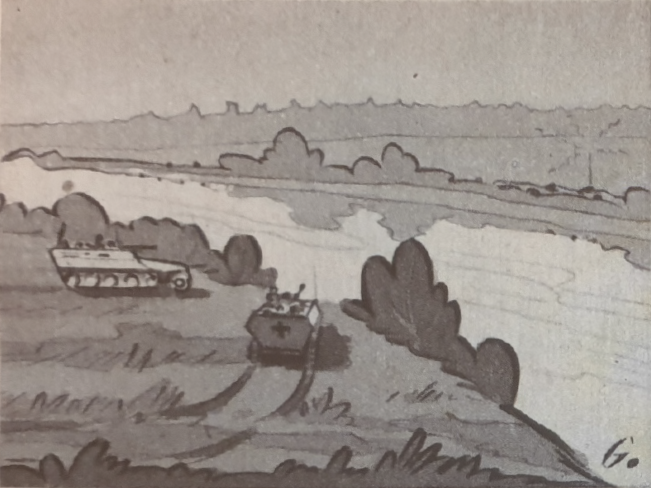
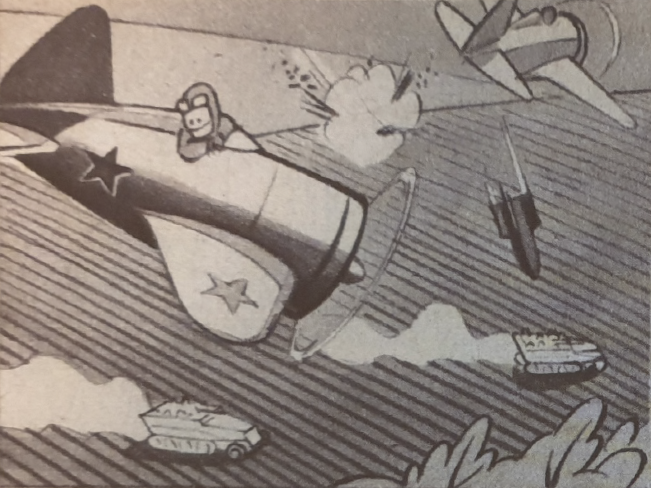
NOTE:  As with all of the following pages, the above passage was a rhyming poem in the original document.  The numbering for the following pairs of images refer to the page in the original document.

3.
As we are the enemy's greatest fear, he is constantly trying to discover us.

So if you want to fool him, drive the car in the shade.

4.

It is shorter to cross country, but the vehicle tracks remain.


Better keep to the roads, then nobody can guess your route.

5.  
 If you drive too close to the car ahead, you run the risk of being hit by aircraft.

So our slogan should be: The distance between vehicles in motion also applies at the halt.
BH:  This is excellent advice for many reasons.  In CM, for protection maintain a good healthy distance between vehicles.  Not only aircraft, but armor and anti-tank guns love a bunched up target.  

This lesson is also taught in the next pair:

6.
Crossing an obstacle, could cause a huge pile up. 

Don't waste time reorganizing, split to the left and right and spread out.
BH:  Overwatch with part of your force, move with another.  Regardless, don't allow your vehicles to bunch up at a bottleneck (ford, bridge, narrow street, etc.)

7.
If you drive stupidly when in point position, you are of no use to your boss. 

Driving as the point position advance aggressively, but ensure to scout as you crest each rise.
BH:  When crossing a ridge it is always good advice to move into a hull-down position and ensure the way is clear before rushing over the top.

8.
Driving carelessly through the landscape, you can easily be blown up!

Scout out narrow defiles, streets or bridges, to discover mines or similar dangers.

9.
The bright car sticks out, the enemy spotting it will cost you your head. 

Sacrificing yourself senselessly is a sin, pay attention to the proper background.
BH:  It is always a good idea to not silhouette your vehicles against a skyline.  Though CM does not factor in the background behind a vehicle, ensuring you are properly masked from enemy sight is always smart.

10.
Driving blindly out into a field, suddenly with a flash and a crack its over.

Pushing forward pay attention and build up defensive fire.
BH:  This lesson is teaching overwatch.  Definitely have units in overwatch positions when advancing into unknown ground.

11.
If you wish to make an anti-tank gun happy, drive over ridges.

If you wish to live, stick to the folds of the ground.
BH:  If there is one lesson I have been teaching over and over again on this blog and elsewhere it is to mask your movement.  This will also be a common them throughout this pamphlet.  

12.
 If you encounter hostile convoys and halt, the enemy will gain the upper hand.

But with dash and maximum speed, the prey will be yours indeed.

13.
At a river it is absolutely foolish, to drive up to the reed bed. 

Make sure to stop at final cover: the enemy cannot see you but you can spy him.
BH:  Again the lesson discusses properly scouting unknown terrain prior to rushing it.  Must have been a real problem for them to repeat the same lesson in various situations throughout.

14.
 Aircraft will be amused every time you move through clear terrain.

Adapting to the terrain the aircraft will search in vain.

15.
Driving in a dense pack means suffering heavy losses. 

Leave wide gaps, the enemy's fire will fall with little effect.
BH:  The above obviously is referring to enemy artillery, however this is a good lesson for all situations, don't give the enemy simple fire solutions.

16.
When under artillery fire never stop for any reason. 

If an area is under artillery fire dash on, then you'll hardly notice it.

17.
Driving stupidly through an open field will lead you straight to St. Peter. 

Use every cover you can find, bushes, trees, fences, or houses.

18.
Making wide curves when turning means death for men and vehicles. 

Throw smoke to block the view, then retreat immediately.


19.
Firing while driving will suppress and pin but you can only wipe them out when you come to a stop. 

It has proven itself:  One shoots and one drives.
BH:  This lesson teaches Fire and Movement.  Suppress with part of your force and maneuver to assault with the remainder.

20.
Staying in an exposed position will certainly go wrong. 

Choosing a defilade position means not becoming a target for the enemy.
BH:  Hull down positions are life savers.

21.
Choose a position in the open and you will definitely be hit hard. 

Choose your position with cleverness, neatly masked and concealed.

 22.


Driving the vehicle in the position shown above will drive you mad.

The wise man chooses that cover which allows him to fire fastest.
BH:  Basically if you can't be spotted easily, you have an advantage.

23.
Attacking tanks from the front is suicide. 

Take cover from a flanking position to attack the tank with the 7.5cm is a good idea.

24.
 When driving amidst tanks you might hit a mine, idiot.

Be clever  follow in the tracks made by the tanks.

25.
If you drive slowly when attacking, bulls-eye and its over. 

Stay on the gas and don't fall behind!

26.
Crossing trenches diagonally ignores a main principle.

Cross trenches at a right angle then you'll make it.  Remember that! 

27.
The group is waiting and you are swearing because you've lost your way.

Make sure to remember to hit your landmarks, your route, and the time.

28.
Driving forward into cover will mean pulling back out could be difficult.

Backing into cover, saves time and work when departing.
BH:  Seems simple, but this is a really good lesson.  Works at the grocery store too.  :)

29.
Turning leaves your tracks bright and obvious that even mooncalves can spot in the darkness. 

So dear driver do not be stubborn, cover your tracks.
BH:  Mooncalves?


30.
With the commander snoring deeply and loud the vehicle gets stuck in marshy ground. 

So commander, drum it into your head:  Better get off the car and guide your mates.
BH:  I would like to see the accident report that inspired this one.

31.
 A lone scout is in danger of getting blown out.

But two together, that for sure will give you a feeling of security.
BH:  When scouting it is always best to do it in pairs.  This allows overwatch and the additional firepower can help get you out of a jam.

32.
A radio operator moving his equipment to a place where wires and walls become his grave. 

So put your vehicle in a good position where radio waves can emit at full strength.

Again, huge thanks to Holger on this post... couldn't have put it up without him.  Bil